At a Glance: Challenging Assumptions About the Future Workforce
Organisations across every sector are asking the same question: “How do we engage the future workforce?”
That was the starting point for Participation People’s keynote at IGD’s People Leaders Forum. But what quickly became clear was that this wasn’t simply an engagement challenge. It was a relevance one.
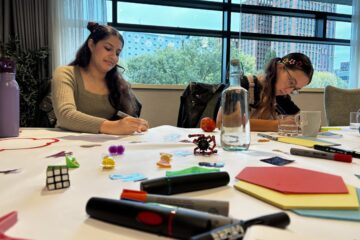
Co-delivered by Founder & CEO Antonia Dixey alongside Young Consultants Jeremy (19) and Chloe (21), the session brought authentic future workforce insights directly into the room. Rather than speaking about young people, leaders heard directly from them—challenging assumptions, testing ideas and exploring what the future workforce is really telling employers.
About IGD
IGD, the Institute of Grocery Distribution, is a global organisation that brings together retailers, manufacturers and industry leaders to shape the future of food and consumer goods.
Through its Feeding Britain’s Future programme, IGD supports organisations to better understand emerging workforce trends and prepare for the changing expectations of future employees.
Recognising that meaningful workforce strategies should be informed by the people they are designed for, IGD partnered with Participation People to bring lived experience and future workforce insights directly into the conversation.
A Different Kind of Session
Rather than delivering a traditional keynote, the session immersed senior People Leaders in the world Gen Z navigates every day. Fast, filtered and values-driven.
Using a live Gen A ↔ Gen Z quiz, real-time polling, workplace experiences and lived insights from Jeremy and Chloe, we didn’t simply talk about the future workforce. We tested assumptions, challenged norms and surfaced blind spots through direct conversation with the next generation of employees.
Almost immediately, the energy in the room shifted. Delegates went from discussing Gen Z as a demographic to understanding them as colleagues, consumers and future leaders.
The Moment It Landed
One question set the tone.
How long do you have to engage Gen Z in a communications campaign?
The answer: Just 1.7 seconds.
A pause.
A few surprised looks.
Then recognition.
Because this isn’t just about marketing. It’s about how Gen Z experiences everything:
- your brand
- your onboarding
- your leadership
- your policies
- your workplace culture
In that moment, the conversation shifted from:
“How do we reach the future workforce?”
to
“Are we showing up in a way that earns their attention?”
What the Data Is Really Saying
Throughout the session, Jeremy and Chloe anchored the discussion in data—not as statistics to memorise, but as signals to interpret.
These included:
- 54% of Gen Z feel their employer takes mental health seriously.
→ Which means almost half don’t. - 75% consider an organisation’s societal impact when choosing where to work.
→ Purpose isn’t simply a nice-to-have. It increasingly influences where early-career talent chooses to invest their future. - 85% prefer chat or automated communication over phone calls.
→ Communication expectations have fundamentally shifted for consumers, employees and brand advocates alike. - Gen Z are exposed to between 4,000 and 10,000 digital adverts every day.
→ Attention isn’t just short, it’s highly selective. - 40% use platforms like TikTok as a search engine instead of Google.
→ Trust, discovery and credibility now live in very different places.
Taken together, these aren’t isolated statistics.
They are signals that the future workforce is increasingly intentional about where it invests its attention, time, energy and trust.
What Leaders Recognised
As the session unfolded, leaders reflected honestly and, at times, uncomfortably.
There was shared recognition that:
- many current strategies were designed for a different generation
- communication often remained top-down rather than participatory
- uncertainty still exists around what good employment feels like for first-time entrants to the workforce
Perhaps most importantly, there was a growing willingness to replace assumptions with curiosity—recognising that understanding Gen Z begins with listening, not guessing.
Three Mindset Shifts That Changed the Conversation
From Polished to Real
Gen Z doesn’t expect perfection, but they do expect honesty.
Over-produced messaging can feel distant, and trust is built through:
- real voices
- visible people
- authentic communication
From Purpose Statements to Proof
It’s no longer enough to say you care about mental health, sustainability, neurodiversity or inclusion.
The future workforce is asking: “Show me.”
They are looking for:
- consistency
- transparency
- visible role models
- follow-through
From Engagement to Participation
Perhaps the biggest shift of the day was this:
Gen Z doesn’t simply want to be engaged with. They want opportunities to shape what comes next.
That means moving beyond:
- annual engagement surveys
- one-off consultations
- six-monthly appraisals
Towards:
- leadership shadowing
- intergenerational problem-solving hackathons
- shared decision-making
- policy co-creation
From Insight to Action
By the end of the session, leaders weren’t asking for more theory. They wanted practical actions they could begin applying immediately.
These included:
Start…
- Designing with younger employees (and customers), not for them
- Communicating in shorter, more visual and more authentic ways
- Linking roles clearly to purpose and impact
- Showing people how their contributions have made a difference
- Creating ongoing feedback loops rather than one-off consultations
Stop…
- Over-engineering messaging
- Relying solely on traditional communication channels
- Treating engagement as a campaign rather than a culture
- Assuming visibility equals relevance
- Keeping leadership at arm’s length
A Wider Shift Is Already Happening
This isn’t a future trend—it’s already underway.
Across workplaces, we’re seeing a shift:
- from hierarchy to participation
- from broadcast to dialogue
- from loyalty to alignment
- from linear careers to flexible career portfolios
With 46% of Gen Z already having a side hustle, expectations around work, identity and progression are continuing to evolve. As organisations, it’s our role to make sure they evolve with them.
Where This Leaves Organisations
By the close of the session, one thing was clear:
This isn’t about fixing the future workforce. It’s about evolving organisational thinking.
The organisations most likely to attract and retain emerging talent won’t necessarily be those that communicate louder or produce more content.
They’ll be the ones that:
- listen better
- involve young people meaningfully
- adapt visibly
Final Reflection: From Assumption to Action
The conversation didn’t end when the keynote finished.
It sparked a wider appetite to explore how future workforce insights could shape organisational strategy, leadership and workplace culture.
Because awareness alone isn’t enough.
The real opportunity lies in turning insight into action, and action into lasting organisational change.
Gen Z isn’t asking organisations to be perfect. They’re asking them to be authentic, responsive and willing to evolve.
At Participation People, we believe the best decisions about young people are made with them, not simply for them. If you need to invite young people into the room, get in touch.